
How to bake sourdough without a Dutch oven, and what replaces it
How to bake sourdough without a Dutch oven comes down to one job: trapping steam around the loaf for the first 20 minutes. Invert a stainless bowl or roasting pan over the dough on a preheated stone or steel and you get the same effect. A cast-iron combo cooker works too.
Why a Dutch oven works at all
You never add water to a Dutch oven, and that's the trick. A shaped loaf is roughly 40% water by weight; seal it in a few quarts of hot air and its own evaporating moisture saturates that space in a minute or two.
That humid air condenses on the cooler dough surface and keeps the skin extensible while the interior expands. Surface starch gelatinizes into a thin glossy film instead of drying into a shell, so the loaf gets its full oven spring and the cut opens where you put it — which is why sourdough scoring only pays off in a steamy first phase.
A home oven can't reproduce that on its own, because it vents. Dutch oven sourdough wins on volume, not water: a tight lid over four quarts of air beats a cup of water in a five-cubic-foot box.
How to bake sourdough without a Dutch oven: the substitutes ranked
Each option is judged on one thing: how well it holds the loaf's own moisture for 20 minutes.
| Method | Steam seal | Preheat | Fits | Main weakness |
|---|---|---|---|---|
| Cast-iron combo cooker | Excellent | 45–60 min | 800–1000 g boule | Shallow lid; tall loaves touch |
| Inverted roasting pan over steel | Very good | 60 min | Boule or batard | Must preheat both pieces |
| Inverted stainless bowl over steel | Good | 60 min | Boule to ~900 g | Thin metal stores no heat |
| Steel plus a pan of lava rocks | Fair | 60 min | Two loaves at once | Steam escapes; add water |
| Sheet pan, uncovered, water tray | Poor | 20 min | Anything | Crust sets early; flat loaf |
Cast-iron combo cooker
A shallow skillet as the base, the deep pan inverted on top as the lid. The seal matches a Dutch oven's, and loading is easier: you turn the loaf out onto a flat surface instead of reaching into a six-inch well. The common 10.25-inch size handles a 900 g dough, though a lively loaf can touch the shallow lid.
Inverted roasting pan over a baking steel
The best option if you already own a steel or a stone. Set the loaf on the preheated surface, drop the roasting pan over it upside down, lift it off at 20 minutes. Preheat the pan too — cold metal pulls heat out of the loaf's air space.
Inverted stainless bowl
The cheapest fix. Use a bowl of at least 5 quarts so the dome clears the risen loaf, and confirm it's all metal: no silicone rim, no plastic-cored handle. Thin stainless stores no heat, so the stone underneath does the real work.
Baking steel with a pan of lava rocks
The only method here that scales to two loaves, and the only one where you add water yourself. Lava rocks in a cast-iron skillet on the bottom rack give enough surface area that half a cup of boiling water flashes to steam instantly instead of simmering. A stainless chain or a rolled cotton towel does the same job. Never use glass or ceramic for the water pan. Making steam in the oven for bread this way is less effective than a lid, because the oven keeps venting it.
What size Dutch oven for sourdough bread
For a 900 g boule, a 4–5 quart round. For batards, a 5–7 quart oval. A pot about two inches wider than your banneton is the practical rule.
Oversized is a real fault, not a safe default: extra airspace dilutes the loaf's moisture and a slack boule spreads across the extra floor before it sets. Undersized is worse, since the dough welds itself to the lid. Judge dutch oven size for sourdough by finished dough weight — 500 g of flour at 75% hydration lands near 900 g of dough once salt and starter are in.
On enameled pots the knob, not the pot, is often the temperature ceiling. Older phenolic knobs are rated well below the 500 °F many recipes call for, so check yours before a hot preheat.
The preheat almost every failure traces back to
Cast iron lags the oven badly. The thermostat beeps when the air is up to temperature; several pounds of metal are nowhere near it. Give a Dutch oven or combo cooker 45–60 minutes at full heat, a steel or stone a full hour.
An under-preheated base shows up as a pale soft bottom, a loaf that spread before it sprang, and a blunt ear. That reads like a proofing fault, which is why it gets misdiagnosed — check your bake time and temperature first.
Cold-start baking is a separate method, not a shortcut: loaf into a cold pot, into a cold oven, switch it on. Spring is milder and preheated timings don't transfer.
The uncovered bake, where crust color is decided
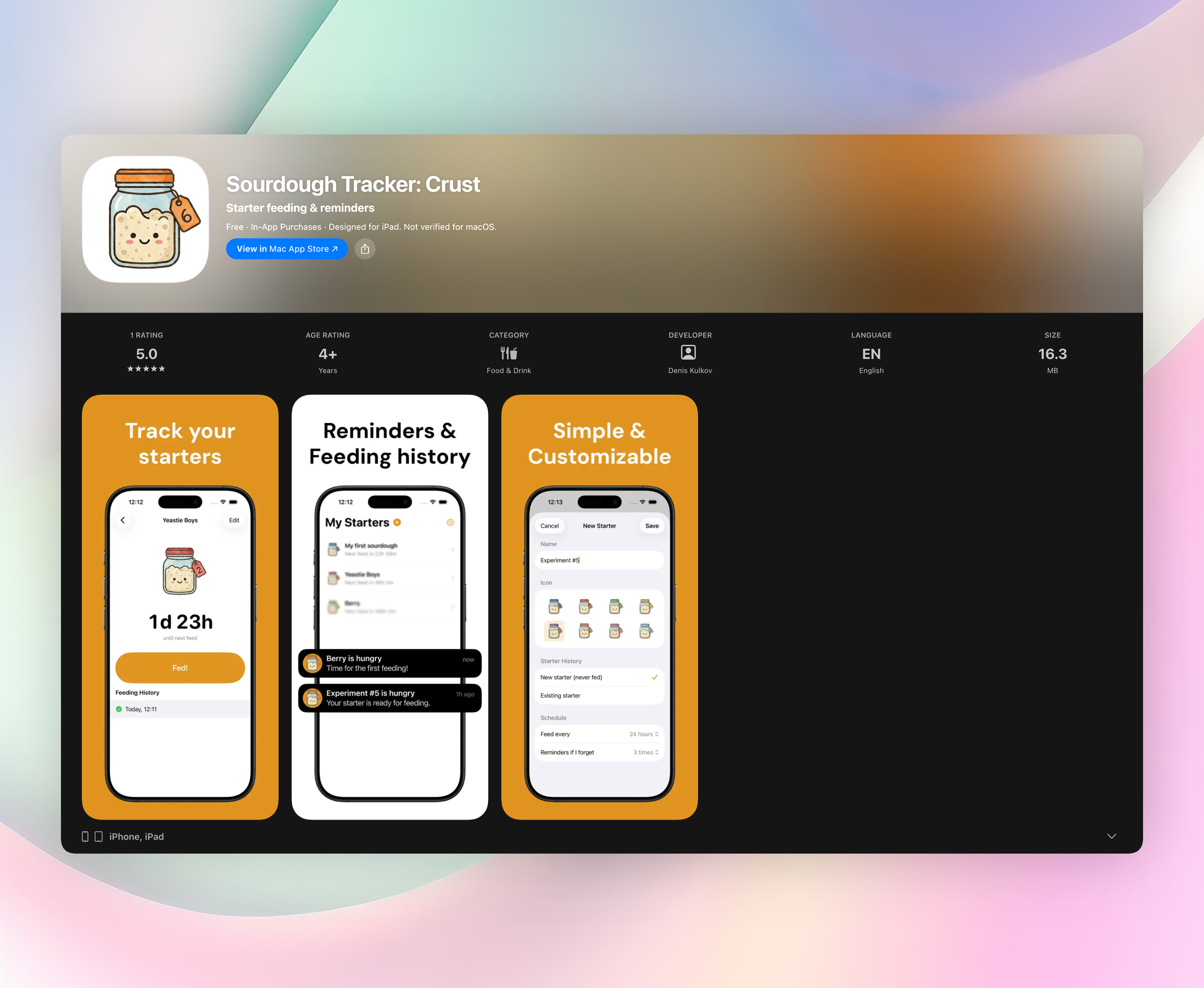
Once the lid comes off around the 20-minute mark, steam stops mattering. Everything after that is temperature multiplied by time, and landing that switch at a consistent minute is most of the battle — Sourdough Tracker, a sourdough baking companion app for iPhone, times the covered and uncovered phases so the lid comes off at the same minute every bake.
Sourdough not browning usually traces to one of three things. The dough was over-fermented and the sugars are gone, leaving nothing for the Maillard reaction — a tight, gummy crumb is the tell. The oven runs cold, and dial calibration drifts more than people expect. Or the lid stayed on too long and the surface never dried out.
A sourdough crust too hard to slice is the opposite error, and it comes from the length of the dry phase more than the heat. Long moderate uncovered bakes build thick leathery crust; shorter hotter ones give a thin crackly one. Leaving loaves in a cooling oven with the door propped adds more drying on top. Pull at 205–210 °F internal.
Judge the crust after a couple of hours, not at the oven door. Moisture migrates outward as the loaf cools, and a shell that seems armor-plated at 15 minutes often slices cleanly later.
FAQ
Can I bake sourdough with no cover at all?
You can, and it will be edible, but the crust sets within the first few minutes and the loaf stops expanding early. Expect less volume and a torn score instead of a clean ear. Bake hotter and score shallower to compensate.
How much water do I need if I can't cover the loaf?
About half a cup, poured onto preheated lava rocks or a heavy metal pan the moment you load the bread. More water doesn't help, since a home oven vents it. Never use a glass dish, and keep water away from the door glass.
Do ice cubes work as well as boiling water?
They're safer for thermal shock and faster to throw in, but they pull heat out of the oven while they melt. On a preheated pan full of lava rocks the difference is small. In a bare sheet pan, boiling water steams faster.
Why is my bottom crust burning before the top browns?
The pot is sitting on a hot lower element, or on a stone storing too much heat. Move up a rack, slide an empty sheet pan under the pot as a buffer, and skip the stone if you're using a lidded vessel.
Free Sourdough tools
- Baker's Percentage CalculatorEnter flour and other ingredient weights to get baker's percentages, totals and an optional rescaled recipe for your target dough weight.
- Bulk Fermentation Time CalculatorEstimate a sourdough bulk fermentation window from dough temperature, starter percentage and starter activity. Use the result as a prompt to read the dough, not as a fixed finish time.
- Sourdough Bread Internal Temperature GuideChoose a loaf style and flour composition, then enter the measured center temperature to see the relevant sourdough bread internal temperature range and an interpretation.
- Sourdough Bread Timeline PlannerBuild a backwards-planned sourdough bread timeline from starter feeding through mixing, folds, bulk fermentation, shaping, proofing and baking.
- Sourdough Fermentation ChartUse your dough temperature, starter percentage and dough size to build a practical sourdough fermentation chart with a range rather than false precision.
- Sourdough Hydration CalculatorFind your true dough hydration, not just water divided by recipe flour. This calculator includes the flour and water already in your starter.
- Sourdough Proofing ChartEstimate a room-temperature or cold-proof window from proofing temperature and starter percentage, then check the dough's rise, shape and bubbles.
- Sourdough Starter Feeding Schedule PlannerBuild a dated sourdough starter feeding schedule with expected refreshes and a visual readiness window.
- Sourdough Starter Feeding CalculatorWork out how much to feed sourdough starter for a chosen amount or your next bake. Get grams of starter, flour and water, plus discard.
- Sourdough Starter Feeding Ratio CalculatorUse a feeding ratio and target hydration to calculate the grams of starter, flour and water to combine, plus total weight and discard.
- Sourdough Starter Grams to Cups ConverterHow many grams is 1 cup of sourdough starter? Use this approximate converter for cups, grams, hydration, and the flour and water your starter contains.
- Sourdough Starter Name GeneratorGenerate a shareable batch of sourdough starter names by vibe, flour type and starting letter. Re-roll or copy your favourites in one click.
- Sourdough Starter Peak Time EstimatorEstimate when a mature sourdough starter may peak from its feeding ratio, ambient temperature and feeding time, then check the visual cues that matter more than the clock.