
How to store sourdough bread without wrecking the crust
How to store sourdough bread depends entirely on when you plan to eat it: cut-side down on a board for day one, a paper bag or bread box through day three, the freezer for anything longer. Skip the fridge. It stales bread faster than the counter does.
How to store sourdough bread, ranked by how long you need it
Every method trades crust against crumb. Nothing preserves both — a crisp crust needs air, a soft crumb needs its moisture held in.
| Method | Crust | Crumb | Best for |
|---|---|---|---|
| Cut-side down on a board | Stays crisp | Softens slowly | First 24 hours |
| Paper bag | Mostly crisp | Dries steadily | Days 1–3 |
| Bread box | Firm, not crackly | Stays soft | Days 1–3 |
| Linen or beeswax wrap | Softens | Stays soft | Days 1–2 |
| Plastic bag | Goes leathery | Stays soft longest | Sandwich slices |
| Freezer, double wrapped | Comes back with heat | Preserved | Anything past day 3 |
| Refrigerator | Goes leathery | Stales fastest | Nothing |
Day one: cut-side down, crust bare
Cut the loaf, then stand it on its cut face on a wooden board. The bread seals its own exposed crumb against the wood while the crust — the part you spent 45 minutes and a screaming-hot dutch oven on — stays open to the air and stays crisp. No bag, no wrap, no container.
This only works if the loaf was fully cool before you cut it. Sliced warm, it loses steam it still needed and the crumb sets up sticky. Tight, paste-like slices are usually a gummy crumb problem from the bake, not from storage.
Days two and three: paper bag or bread box
Once the cut face has dried a little, move the loaf into a paper bag or a bread box. Paper breathes, so the crust keeps most of its snap while the crumb gives up moisture slowly. A bread box makes the opposite trade: enough trapped humidity to keep the crumb soft, at the cost of a crust that goes from crackly to merely firm.
The best way to store sourdough bread across those two days is whichever trade you care about: bread box for toast-and-butter, paper for slices eaten plain.
Why the fridge and plastic both fail
Staling isn't drying out. It's retrogradation — the starch that gelatinized in the oven slowly recrystallizes, squeezing water out of the gel and leaving a firmer, drier-feeling crumb. That runs fastest at temperatures just above freezing, which is exactly the range a refrigerator holds. Counter bread stales too, only slower. Fridge bread stales while you watch it. Freezing skips the problem entirely: around 0°F, retrogradation effectively stops.
Plastic fails differently. It's near-airtight, so moisture leaving the crumb has nowhere to go but the crust, which turns leathery within hours. The crumb does stay softer longer — that's the real trade. A sealed, humid bag is also the friendliest home you can offer a mold spore.
Freezing sourdough bread
Freezing is the only method that pauses the clock. Four things matter.
Cool completely. Wrapping a loaf that's still warm in the middle traps steam, which becomes ice, which becomes a soggy crust on thaw. A 900g boule can hold heat for three or four hours — give it the full time, and make sure it was baked through to begin with.
Pre-slice. Freeze a loaf whole and you're committed to thawing the whole thing. Sliced, you take two pieces and the rest stays frozen.
Double wrap. Plastic or a zip bag pressed flat against the bread, then foil or a second bag. Freezer burn is sublimation; two layers slow it enough to matter.
Toast from frozen. Don't thaw slices on the counter — they'd sit right in the band where staling is quickest. Straight into the toaster, one notch higher than usual. For a whole loaf, thaw it wrapped at room temperature, then spritz the crust with water and give it about 10 minutes at 375°F. Heat above roughly 140°F reverses retrogradation, which is why a tired loaf revives in the oven — for a few hours, anyway. That trick works once per loaf.
How long does sourdough bread last
On the counter, a homemade loaf peaks the day it's baked, stays good through day three, and becomes toast material around day four or five. Sourdough gets a little more room than straight-yeast bread: the lactic and acetic acids from fermentation leave the crumb more acidic, and mold establishes more slowly in acid.
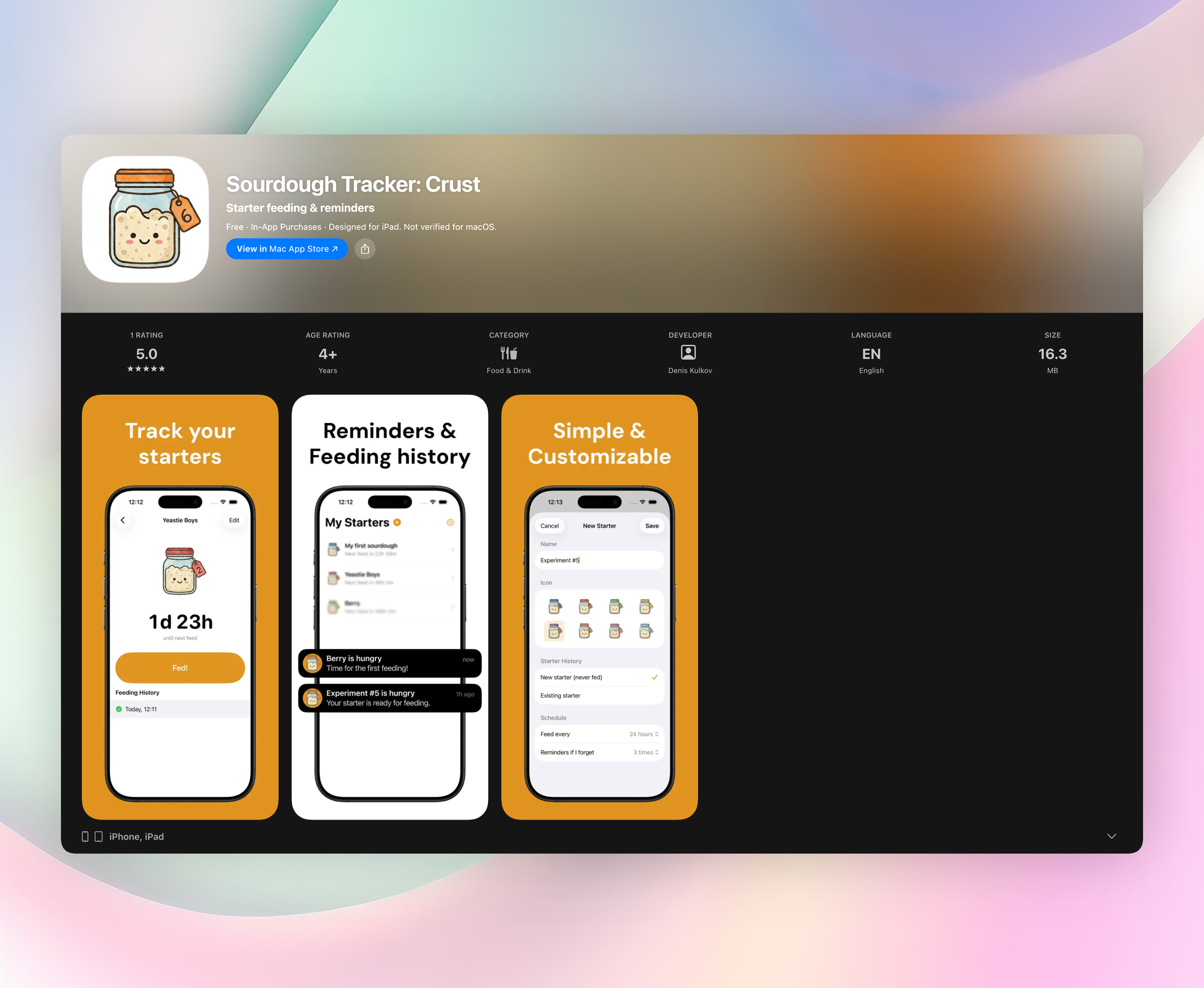
Bake dates blur together once you're baking weekly. Sourdough Tracker, a sourdough baking companion app for iPhone, records each bake date, so the loaf on the counter has an actual age instead of a guess.
Supermarket sourdough is a different animal: many commercial loaves are yeast-risen with added flavoring and lack that acidity.
Sourdough bread mold, and when to bin the loaf
Sourdough bread mold shows up as fuzzy spots — green, black, white, or pink — usually on the cut face or tucked into a fold of the crust. Bread is soft and porous, so the visible patch is only part of what's there; the mold's root threads run well past it. Cut off the spot and eat the rest, and you're eating the rest of the mold. Standard food-safety guidance is to discard the whole loaf.
Hard, dry, and pale isn't mold — that's stale, and it makes fine croutons. Same for the chalky bloom of rice flour left by a banneton. None of this applies to your starter, either: hooch, gray liquid, and a sharp acetone smell on a neglected starter are normal, and keeping a starter in the fridge follows its own rules.
How to keep sourdough fresh comes down to not building the conditions mold wants: cool the loaf fully, keep it out of sealed plastic at room temperature, and freeze whatever you won't finish in three days.
FAQ
Can you freeze sourdough bread?
Yes, and past day three it's the best option there is. Cool the loaf completely, slice it, double wrap it, freeze. Toast slices straight from frozen — thawing on the counter walks them back through the band where bread stales fastest.
Should sourdough bread go in the fridge?
No. A refrigerator sits right in the range where starch recrystallizes quickest, so a loaf stales there noticeably faster than on the counter. The freezer is cold enough to halt the process; the fridge only speeds it up.
How do you keep a sourdough crust crisp?
Leave it uncovered, cut-side down on a board, for the first day. Anything holding moisture against the loaf — plastic above all — pushes crumb moisture into the crust. If the crust has already softened, five to ten minutes in a 375°F oven brings the snap back.
How long does sourdough bread last after freezing?
Roughly three months at 0°F for good flavor and texture. It stays safe well beyond that, but it picks up freezer odors and loses aroma the longer it sits.
Free Sourdough tools
- Baker's Percentage CalculatorEnter flour and other ingredient weights to get baker's percentages, totals and an optional rescaled recipe for your target dough weight.
- Bulk Fermentation Time CalculatorEstimate a sourdough bulk fermentation window from dough temperature, starter percentage and starter activity. Use the result as a prompt to read the dough, not as a fixed finish time.
- Sourdough Bread Internal Temperature GuideChoose a loaf style and flour composition, then enter the measured center temperature to see the relevant sourdough bread internal temperature range and an interpretation.
- Sourdough Bread Timeline PlannerBuild a backwards-planned sourdough bread timeline from starter feeding through mixing, folds, bulk fermentation, shaping, proofing and baking.
- Sourdough Fermentation ChartUse your dough temperature, starter percentage and dough size to build a practical sourdough fermentation chart with a range rather than false precision.
- Sourdough Hydration CalculatorFind your true dough hydration, not just water divided by recipe flour. This calculator includes the flour and water already in your starter.
- Sourdough Proofing ChartEstimate a room-temperature or cold-proof window from proofing temperature and starter percentage, then check the dough's rise, shape and bubbles.
- Sourdough Starter Feeding Schedule PlannerBuild a dated sourdough starter feeding schedule with expected refreshes and a visual readiness window.
- Sourdough Starter Feeding CalculatorWork out how much to feed sourdough starter for a chosen amount or your next bake. Get grams of starter, flour and water, plus discard.
- Sourdough Starter Feeding Ratio CalculatorUse a feeding ratio and target hydration to calculate the grams of starter, flour and water to combine, plus total weight and discard.
- Sourdough Starter Grams to Cups ConverterHow many grams is 1 cup of sourdough starter? Use this approximate converter for cups, grams, hydration, and the flour and water your starter contains.
- Sourdough Starter Name GeneratorGenerate a shareable batch of sourdough starter names by vibe, flour type and starting letter. Re-roll or copy your favourites in one click.
- Sourdough Starter Peak Time EstimatorEstimate when a mature sourdough starter may peak from its feeding ratio, ambient temperature and feeding time, then check the visual cues that matter more than the clock.